

Difference Between Testosterone Cypionate, Enanthate & Propionate (Test C vs Test E vs Test P)
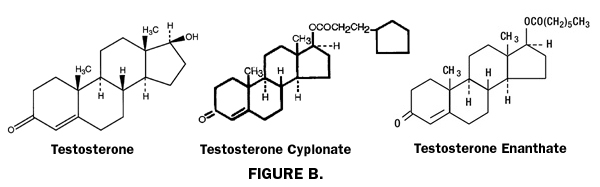
Testosterone is the primary male hormone responsible for muscle growth, strength, recovery, libido, and overall vitality. In medical science, testosterone is prescribed in different ester forms to control how fast or slow it is released into the bloodstream.
The three most commonly discussed forms are:
- Testosterone Cypionate (Test C)
- Testosterone Enanthate (Test E)
- Testosterone Propionate (Test P)
This article explains the differences between Test C, Test E, and Test P in simple terms — covering release speed, duration, and general use cases — for educational purposes only.
What Does “Ester” Mean in Testosterone?
Testosterone esters are attached to the testosterone molecule to:
- Control how long testosterone stays active in the body
- Reduce how frequently injections are required
👉 The ester does not change testosterone itself — it only affects release speed and half-life.
1. Testosterone Cypionate (Test C)
Testosterone Cypionate is a long-acting ester commonly prescribed in medical testosterone replacement therapy (TRT).
Key Characteristics:
- Release Speed: Slow
- Half-life: ~8–12 days
- Stability: Very stable blood levels
- Injection Frequency: Less frequent
General Overview:
Test C provides a gradual and sustained release of testosterone. Because of its long half-life, hormone levels remain relatively stable, which may reduce sharp fluctuations.
2. Testosterone Enanthate (Test E)
Testosterone Enanthate is another long-acting testosterone ester, very similar to Test C and widely used globally.
Key Characteristics:
- Release Speed: Slow
- Half-life: ~7–10 days
- Stability: Stable, slightly faster than Cypionate
- Injection Frequency: Less frequent
General Overview:
Test E and Test C are often considered interchangeable. The main difference lies in slightly faster absorption with Enanthate, though for most individuals, the effect feels very similar.
3. Testosterone Propionate (Test P)
Testosterone Propionate is a short-acting ester with a much faster release.
Key Characteristics:
- Release Speed: Fast
- Half-life: ~2–3 days
- Stability: More fluctuations
- Injection Frequency: More frequent
General Overview:
Because Test P enters and exits the bloodstream quickly, it requires more frequent administration to maintain consistent levels. It reaches peak levels faster but also clears sooner.
Test C vs Test E vs Test P – Quick Comparison
| Feature | Test C | Test E | Test P |
|---|---|---|---|
| Ester Length | Long | Long | Short |
| Release Speed | Slow | Slow | Fast |
| Half-Life | 8–12 days | 7–10 days | 2–3 days |
| Blood Level Stability | High | High | Moderate |
| Injection Frequency | Low | Low | High |
| Peak Speed | Slow | Slightly faster | Fast |
Which Testosterone Ester Is “Better”?
There is no universally “better” option.
The choice depends on:
- Medical guidance
- Treatment goals
- Individual response
- Lifestyle and consistency
👉 From a scientific perspective:
- Long esters = steadier levels, fewer fluctuations
- Short esters = faster action, more control, but more frequent dosing
Important Health & Legal Note
⚠️ Testosterone is a prescription-only medication in India.
It should be used only under qualified medical supervision.
Misuse or unsupervised use may lead to:
- Hormonal imbalance
- Cardiovascular strain
- Liver stress
- Natural testosterone suppression
Final Thoughts
Understanding the difference between Testosterone Cypionate, Enanthate, and Propionate helps in making informed decisions from an educational and scientific standpoint.
At HSF Nutrition, we believe:
Knowledge, safety, and informed choices always come first.
📌 Disclaimer
This article is intended for educational and informational purposes only.
HSF Nutrition does not sell or promote prescription drugs online.
Always consult a qualified medical professional before considering any hormone-related therapy.